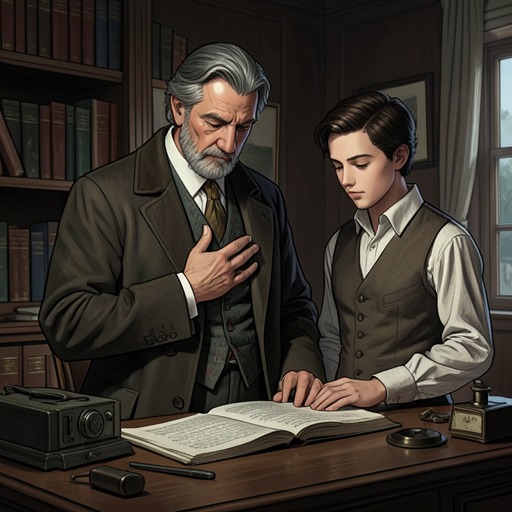
Harry and Professor Hardwigg
A Journey to the Centre of the EarthHarry and Professor Hardwigg are bound by family affection and shared exposure to danger, yet their expedition repeatedly turns them into opposing interpreters of evidence. Harry challenges the Professor’s certainty with scientific objections and direct observations; the Professor answers with confidence in his own judgment and in the precedent of an earlier traveller. Their relationship’s decisive change comes when Harry is lost and presumed near death: the Professor’s search, tears, and insistence that they must never separate make visible the devotion that argument and impatience had obscured.
Intellectual Opposition
The contrast is already clear in their dispute about whether the journey into the Earth’s interior is possible. Harry accepts that Saknussemm found an entrance, but considers it madness to suppose that anyone could have followed the discovery, because scientific teaching makes the undertaking impossible. Professor Hardwigg dismisses theory as a reason to stop. When Harry invokes the familiar estimate that temperature rises with depth and argues that the Earth’s materials would be incandescent or molten, the Professor does not yield to the calculation. Their disagreement is not simply between belief and disbelief: Harry reasons from accepted scientific principles, while the Professor treats those principles as insufficient to overrule the possibility of a successful expedition.
The same difference governs the Professor’s reading of volcanic signs. He explains that steam vents become more active before an eruption and disappear during one, when elastic fluids retreat into the crater; if the steam remains normal, its force does not increase, and the wind is not displaced by heavy pressure and stillness, he judges an immediate eruption unlikely. Harry asks how the signs can justify that conclusion, but the Professor ends discussion by insisting that science has spoken and should be obeyed. The exchange shows the authority he claims for scientific interpretation even as Harry’s questions expose how much the expedition depends on reading uncertain evidence correctly.
Evidence and Interpretation Underground
Their conflict sharpens when physical discoveries appear to challenge the Professor’s assumptions. Harry sees fossil outlines, picks up an almost complete shell, and asks what conclusion should follow from it. The Professor identifies it as a shell of an extinct trilobite and treats the identification as sufficient, while Harry presses beyond naming the object to ask what its presence means. The distinction recurs throughout their relationship: the Professor can accommodate an observation without accepting the larger inference Harry draws from it.
Their dispute over depth makes that divide concrete. Harry calculates that they have travelled sixteen leagues, or fifty miles, and notes that this is the extreme limit allowed by science for the thickness of the Earth’s crust. He further points to the expected temperature at that depth and, later, to the enormous depth beneath Iceland implied by the Professor’s own calculations. Harry considers whether the extinct volcanic chimney’s lava might resist heat and conduct it poorly, but rather than continue a futile argument, he says he will take the facts as they are. When he calculates that the route’s horizontal distance would carry them far from the centre before they could reach it, the Professor rejects the reasoning and invokes a precedent: another person undertook the journey and succeeded. His confidence rests not only on theory, but on the example of Saknussemm; Harry’s caution rests on the mismatch between that example and the measurements before them.
Strain and Dependence
The disagreement becomes personal when the party faces a shortage of water. Harry, furious and distressed, tries to make Hans leave, but his uncle intervenes and tells him that he will get nowhere with the devoted guide. The Professor then identifies the lack of water as the sole obstacle to his project and proposes that they may fare better in the western tunnel. His response reframes a crisis Harry experiences as a reason to escape as a problem that might still be overcome in pursuit of their goal. The scene exposes both Harry’s desperation and the Professor’s determination, while showing the uncle stepping between Harry and an argument that cannot move Hans.
Their relationship is most severely tested when Harry becomes separated in the underground labyrinth. Weak and unable to speak easily, he begs his uncle to keep talking because silence feels like annihilation. The Professor tells him that the explorers have searched in every direction, above and below, and that he had begun to give up hope. Believing Harry might still be on the road beside the Hansbach, they descended again and fired guns as signals. Even after their voices reach one another, the labyrinth’s acoustic arrangement means they may not meet for a long time. The connection is real but incomplete: they can speak across the distance, yet cannot immediately close it.
Rescue and Changed Understanding
When Harry regains consciousness, his uncle watches over him with tears in his eyes. At Harry’s first sign of life, the Professor cries out in joy, takes his hand, and declares him saved. The change is striking in a man previously presented through forceful certainty: the Professor’s anxiety is no longer inferred from his decisions but made visible in his attention to Harry and his tears. Harry’s survival is not treated as an ordinary recovery. The Professor explains that Harry fell down an almost perpendicular gallery amid falling stones and reached him insensible and covered in blood; he calls it a miracle that Harry survived and warns that separating again could mean they never meet.
Harry echoes the promise never to part, but the words also reveal his unease: he understands that the journey is not over. Their reunion therefore resolves the immediate separation without ending the conflict between danger and determination. The Professor’s care does not make him abandon the expedition, and Harry’s relief does not erase his doubts. Instead, the near-loss gives their bond a new weight: continued companionship becomes an explicit necessity, even as they remain committed to a journey whose risks have already brought them close to permanent separation.
Narrative Significance
The relationship gives the expedition an intimate form of its larger contest between inference and experience. Harry repeatedly asks what observations—temperature, fossils, depth, or distance—permit them to conclude, while the Professor resists conclusions that would stop the journey and trusts both his own judgment and Saknussemm’s precedent. Their arguments are consequential because they shape how the dangers are understood, but neither character’s role is reduced to a simple opposition between reason and recklessness: the Professor offers a detailed account of volcanic signs, while Harry sometimes sets aside further debate to accept the facts as they stand.
The separation and reunion alter the emotional terms of that intellectual contest. The Professor’s confidence and impatience coexist with attachment strong enough to drive a renewed search and leave him in tears when Harry awakens. Harry, for his part, can challenge his uncle’s calculations and still depend on his care. Their relationship thus holds together two kinds of commitment: the Professor’s refusal to relinquish the expedition and the pair’s recognition that they must not lose one another within it.